

Agentic Interfaces
One Conversation Across a Call, WhatsApp, RCS, SMS and Your App
Customers do not think in channels. They think they were talking to you about their renewal. Here is what each interface is good at, and how an agent carries one conversation across all of them without losing the thread.
November 10, 2026 · 7 min read
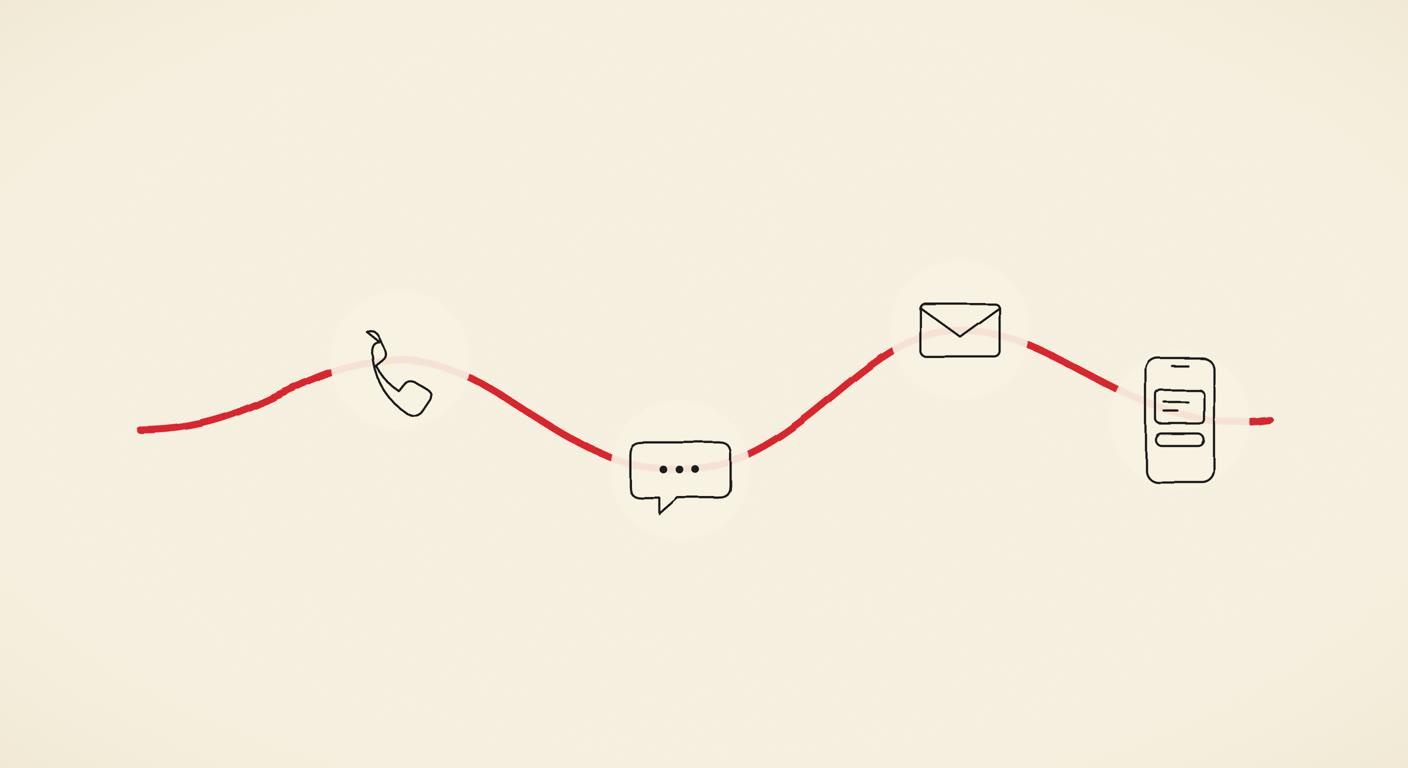
Ask a customer how their renewal went and they will not say "the SMS was fine but the WhatsApp flow had friction". They will say they talked to you about it. Maybe a reminder came in, they asked a question, someone called to explain the price, and they paid on a link. In their head that was one conversation.
Inside most companies it was four. Each channel has its own tool, its own team and its own idea of who the customer is. The customer notices every seam.
We call the alternative agentic interfaces: one agent that can speak through any of them, and that treats a call, a message and a screen as parts of the same conversation. This piece covers what each interface is good at and how the conversation moves between them.
What each interface is good at
None of these is the best channel. Each one does a different job well.
| Interface | Good for | Not good for |
|---|---|---|
| A phone call | Objections, nuance, explaining a price, the customer's own language, anything emotional | Numbers they need to read twice, documents, signatures |
| Replies in the customer's own time, buttons, documents, a thread they can scroll back through | A first contact with no prior permission, long explanations | |
| RCS | Branded, verified messages with rich cards and buttons in the default messaging app | Reaching phones and networks that do not support it yet |
| SMS | Reach. It arrives on every phone, and a short reminder with a link still works | Anything that needs more than two lines |
| Your app or website | Forms, uploads, comparing options, signing, paying, anything with many fields | Starting the conversation. People do not open an app to be sold to |
The mistake is choosing one and forcing every step through it. A loan application by voice alone means reading out account numbers. A renewal by SMS alone means a link to a page that knows nothing about the call last week.
Translating between them
The useful part is the movement between interfaces, and the agent doing the translation so the customer does not have to.
Take a motor renewal. The price has gone up and the customer has gone quiet.
- The agent calls in the evening, when this customer tends to pick up. On the call he says the increase came with no explanation. The agent walks him through it.
- While he is still on the line, the agent sends the breakdown on WhatsApp, because a number you can read is easier to trust than a number you heard.
- He says it makes sense and asks how to renew. The agent sends a link. It opens a screen with his vehicle, his cover and the price already filled in from the call. Nothing to type.
- The call stays on until the screen is up. Then the agent says it will carry on there, and hangs up.
- On the screen he changes his payment method. The agent is there too, in the same voice, and answers a question about the deductible.
- If he had closed the screen halfway, the next step would be a short message the following morning with a link back to the exact place he stopped.
Each move happens because the next part of the job fits a different interface. The agent decides that, not the customer.
The handover is where journeys break
Most journeys do not fail inside a channel. They fail between two. The link opens a generic login page. The app asks for details the customer already gave on the call. The person who calls back has no idea what was said on WhatsApp.
So we treat every handover as a step that has to be designed:
- A link opens the right screen, already filled in with what the customer said, not the front page.
- The call stays connected until the screen has loaded, so nobody is left alone with a spinner.
- Whatever happens on the screen is known on the next call or message, without anyone asking.
Same agent, same voice
Across all of this, the customer hears and reads one agent. Same name, same tone, same language they chose, same brand. If they switched to Tamil or Hindi on the call, the WhatsApp message that follows is in the same language. If they said "not before Friday" on WhatsApp, nobody calls them on Thursday.
That only works because there is one memory of the customer underneath every interface. We wrote about why that matters more than any single channel in your channel mix is misleading you.
What it needs from your side
Fewer integrations than people expect. The agent needs to read what your systems already know about the customer, and to write back what happened: an API into the systems each journey touches, scoped on the walkthrough. Messaging numbers, sender verification and templates for WhatsApp and RCS follow each platform's own approval rules, and we work through those with your team.
Where to start
Pick one journey where customers currently drop between channels. Usually it is the moment a link is sent. Look at what the customer sees when they open it, and how much of what they already said has to be said again. That gap is what agentic interfaces close.
If you want to see it on your own journey, book a walkthrough.
Sibi is the founder of SuprAgent, which builds AI agents that follow up with customers on calls, WhatsApp, RCS, SMS, apps and websites for banks, lenders, insurers and retailers. Before SuprAgent he ran the Samsung Care+, AppleCare+ and Vivo V Shield programs at Servify.
Topics
Want to see this on one of your journeys?
Tell us where your customers go quiet and we will walk you through how the agent would handle it. Or try the product yourself.