

Agentic Interfaces
Most of Your Customers Will Never Open Your App
Banks and insurers put their best experience in the app, then send links to people who never installed it. Why the web has to work as well as the app, why you still want both, and how one agent serves each customer where they are.
November 14, 2026 · 7 min read
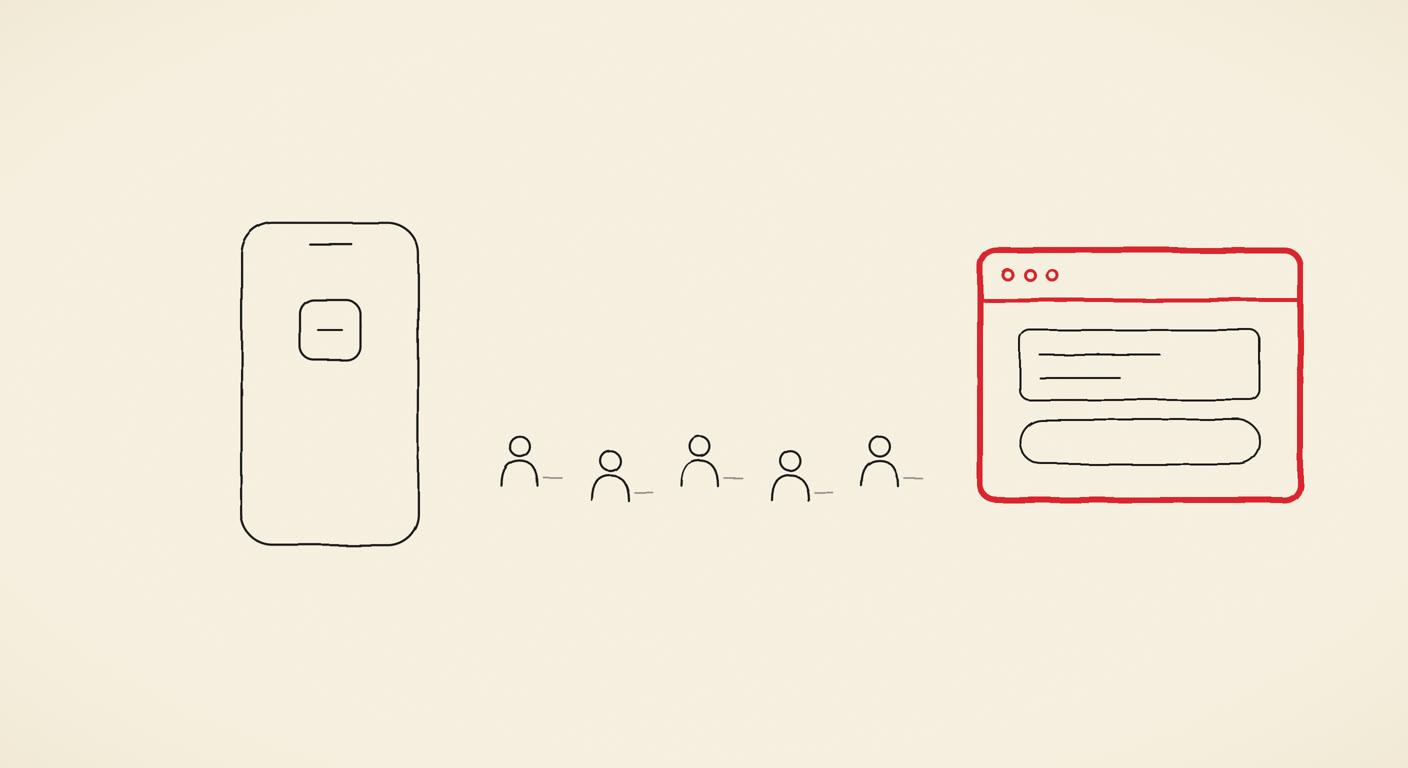
Product teams at banks and insurers spend most of their effort on the app. That is where the good experience lives: biometric login, saved details, push notifications, a design system someone is proud of. Then a renewal reminder goes out with a link, and it lands with a customer who installed the app during onboarding two years ago and deleted it to free up space.
The link opens the app store. Or a login screen asking for a password they set once. Or a mobile site that looks nothing like the app and asks for everything again. Most of them close it.
Who is not in your app
Look at the customers a typical journey needs to reach, and ask how many of them have your app installed, logged in and up to date today.
- Prospects. Anyone who is not a customer yet has no reason to install anything.
- Once a year customers. Insurance is the clearest case. If you only need us at renewal, the app is the first thing you delete.
- Lapsed and dormant customers. Exactly the people a reactivation journey is for.
- People on another device. A work laptop, a shared family phone, a tablet.
- People who simply prefer not to. Older customers, people short on storage, people who distrust apps that ask for permissions.
In most books, that is a large share of the people you are trying to move. Your own numbers will tell you how large. The point is that "send them to the app" quietly excludes them.
What a link should do instead
When a customer taps a link in a message, the screen that opens should work immediately, in the browser, with no install. It should:
- know who they are from the link and a one time code, without a password,
- already contain what they told you on the call or in the message,
- show only what is left to do,
- and have the same agent there to answer questions, by voice or text.
That is a web screen, but it is not your old mobile site. It is built for one journey and one customer at a time, and it is as good as the app for the job in front of it.
You still want the app
This is not an argument against apps. For customers who use your app regularly, it is the best place to finish things: they are already signed in, payment details are saved, push notifications reach them, and you can do more inside it.
So the agent works in both. For a customer who is active in your app, the link opens the app at the right screen. For everyone else, it opens the same screen on the web. If the customer starts on the web and later opens the app, they find the journey where they left it.
One agent behind both
The important part is that the app and the web are not two products with two teams and two versions of the customer. They are two surfaces for the same agent, with the same memory and the same rules.
| App only | Web only | Both, one agent | |
|---|---|---|---|
| Reaches customers without the app | No | Yes | Yes |
| Best experience for active app users | Yes | No | Yes |
| Context carried from the call or message | Sometimes | Sometimes | Always |
| One set of rules and one audit trail | No | No | Yes |
In practice the agent decides per customer. It knows from the record whether someone uses the app, and it sends the link that will actually work for them.
How to see the gap in your own numbers
You do not need anyone's benchmark for this. Your own data answers it.
- Of the customers in one journey, how many have opened your app in the last 90 days?
- When you send a link in that journey, what share of taps end in an app store page or a login screen?
- Of the people who reach that screen, how many finish?
- How many of the people who did not finish were asked for something they had already given you?
Most teams that run this find the biggest drop is not inside the journey. It is at the door.
Where SuprAgent fits
SuprAgent runs the conversation on a call, WhatsApp, RCS or SMS, and the screen that finishes it, in your app or on the web. The same agent, with one memory of each customer. We explain how that memory works across interfaces in your channel mix is misleading you.
If you want to look at one of your journeys together, book a walkthrough.
Sibi is the founder of SuprAgent, which builds AI agents that follow up with customers on calls, WhatsApp, RCS, SMS, apps and websites for banks, lenders, insurers and retailers. Before SuprAgent he ran the Samsung Care+, AppleCare+ and Vivo V Shield programs at Servify.
Topics
Want to see this on one of your journeys?
Tell us where your customers go quiet and we will walk you through how the agent would handle it. Or try the product yourself.