

How It Works
How Our Outbound Autopilot Works
You give the agent a target and the rules. It works out who to contact, when, on which channel and with what, and keeps going until each customer is done or says no. Here is the loop, in plain terms.
October 28, 2026 · 7 min read
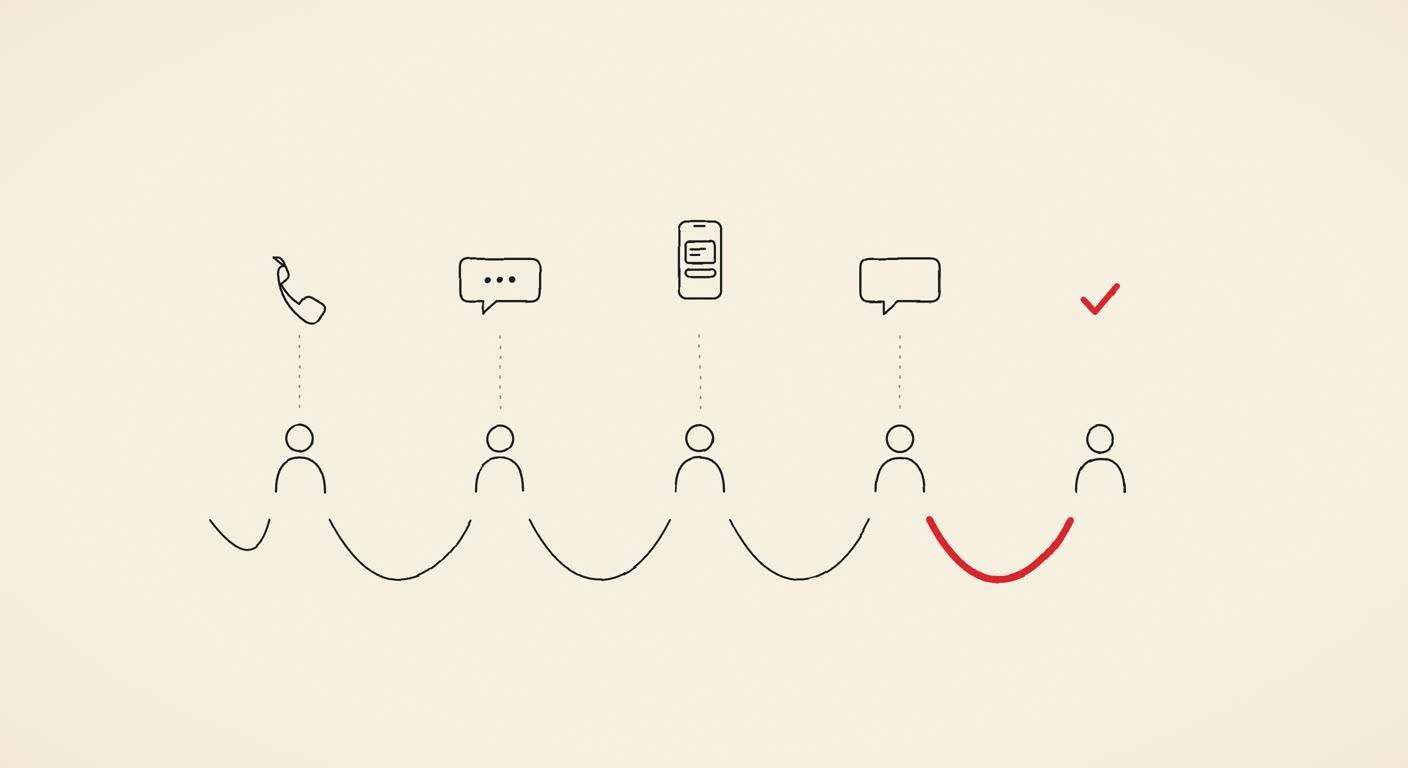
Most outbound still runs as a campaign. Someone picks a list, writes one message, chooses a send time, and a week later reads a report. The people who replied get a follow up. Everyone else gets the same reminder again, a few days later, until the campaign ends.
Your best relationship manager has never worked like that. They know that one customer only picks up after six, that another wants the numbers in writing before any call, and that a third said "after my salary comes in" and meant it. They keep a plan for each person and change it when they learn something.
Outbound autopilot is the part of SuprAgent that works like the relationship manager. This piece explains what it does, step by step, and what your team stays in charge of.
It starts with a target, not a campaign
You give the agent a goal with a number and a date. "Renew 500 motor policies before the 30th." "Get 300 saved loan applications to a decision this month." "Bring back carts over a certain value from the last seven days."
A target also names who the agent may contact, and who it must leave alone. We always keep a group of eligible customers that the agent never touches. That group is how you will know, at the end, what the agent actually changed rather than what would have happened anyway.
Your team writes the rules
Before anything reaches a customer, your team writes down what the agent may and may not do. In plain language, not code. For example:
- What it may offer: the price, the discount ceiling, the tenures it can quote, and what it must never promise.
- When it may make contact: the hours, how many times a week across all channels together, quiet days, and who has opted out.
- What it must say: the disclosures for each product, word for word where they need to be.
- When it must stop, and when it must hand over to a person.
These rules sit above everything else the agent does. If a rule and a good idea disagree, the rule wins. Your compliance team reads them, and so can anyone who wants to know why the agent did something.
Every customer gets their own plan
This is the part that a campaign tool cannot do. For each customer in the target, the agent reads what you already know: what they bought, what they asked last time, which channel they answered before, what time they tend to reply, where they stopped in a journey. Then it writes a plan for that one person.
Three customers on the same renewal list can end up with three different plans:
| Customer | What the record says | The plan |
|---|---|---|
| Frank | Price went up this year, has gone quiet, answers calls in the evening | A call after five, to walk through the price line by line |
| Dana | Opened the quote twice, stopped at the price, replies to texts | A short message in the morning with the number and one button |
| Marcus | Said he would decide at the weekend | Nothing until Monday, then one message |
Every plan comes with its reason, written in a sentence. Nobody has to guess why Marcus was left alone.
Then it does the work, one step at a time
The agent carries out the next step of each plan: a call, a WhatsApp or RCS message, an SMS, or a link that opens a screen with the details already filled in. Then it reads what happened and decides the step after that.
The plan is not fixed. On a call, Frank says the price went up and nobody told him why. The agent was planning to send the renewal notice. It changes course: it explains the increase on the call, sends the breakdown in writing while he is still on the line, and opens the renewal screen for him to confirm. The change, and the reason for it, go in the log.
What the agent learns about each customer from one step feeds the next. How it decides the best channel and moment for each person is a separate piece, how the agent learns who to reach and when.
It knows when to stop
An autopilot that never stops is just a louder campaign. The agent stops working a customer when:
- they finish the journey,
- they say no, or ask not to be contacted again,
- the contact limit you set is reached, counted across every channel together,
- or something comes up that a person should handle. Then it hands over with a summary, so your team does not start from zero.
"Not now" is treated as information, not as a no. If a customer says call me next week, next week is when the agent calls.
What your team sees
Everything the agent does is visible while it happens. For each customer: where they are in the journey, what the agent did last, what it plans next, and why. Across the target: how many have finished, how many are in progress, how many said no, and how that compares with the group it never contacted.
That comparison is the number that matters. We agree what we will measure before the first message goes out, and you see the result either way.
What it does not do
- It does not send the same message to everyone.
- It does not contact anyone more often than your rules allow, on any channel.
- It does not make up a price, an approval or a promise. It quotes what your systems give it.
- It does not decide on its own to reach people outside the target.
Where it fits
Outbound autopilot is one half of SuprAgent. The other half is what happens when a customer answers: the conversation on the call or in a message, and the screen that finishes the job. The same agent does both, with one memory of each customer, which is why a follow up never starts with "as we discussed" when nobody remembers what was discussed.
If you want to see what the plans would look like for your own customers, book a walkthrough. Bring one journey where customers go quiet.
Sibi is the founder of SuprAgent, which builds AI agents that follow up with customers on calls, WhatsApp, RCS, SMS, apps and websites for banks, lenders, insurers and retailers. Before SuprAgent he ran the Samsung Care+, AppleCare+ and Vivo V Shield programs at Servify.
Topics
Want to see this on one of your journeys?
Tell us where your customers go quiet and we will walk you through how the agent would handle it. Or try the product yourself.