

How It Works
How the Agent Learns When to Reach Each Customer, and What to Say
Rules tell the agent what it is allowed to do. They do not tell it what works. Here is how SuprAgent learns, continuously and safely, which channel, which moment and which message fit each customer.
November 4, 2026 · 8 min read
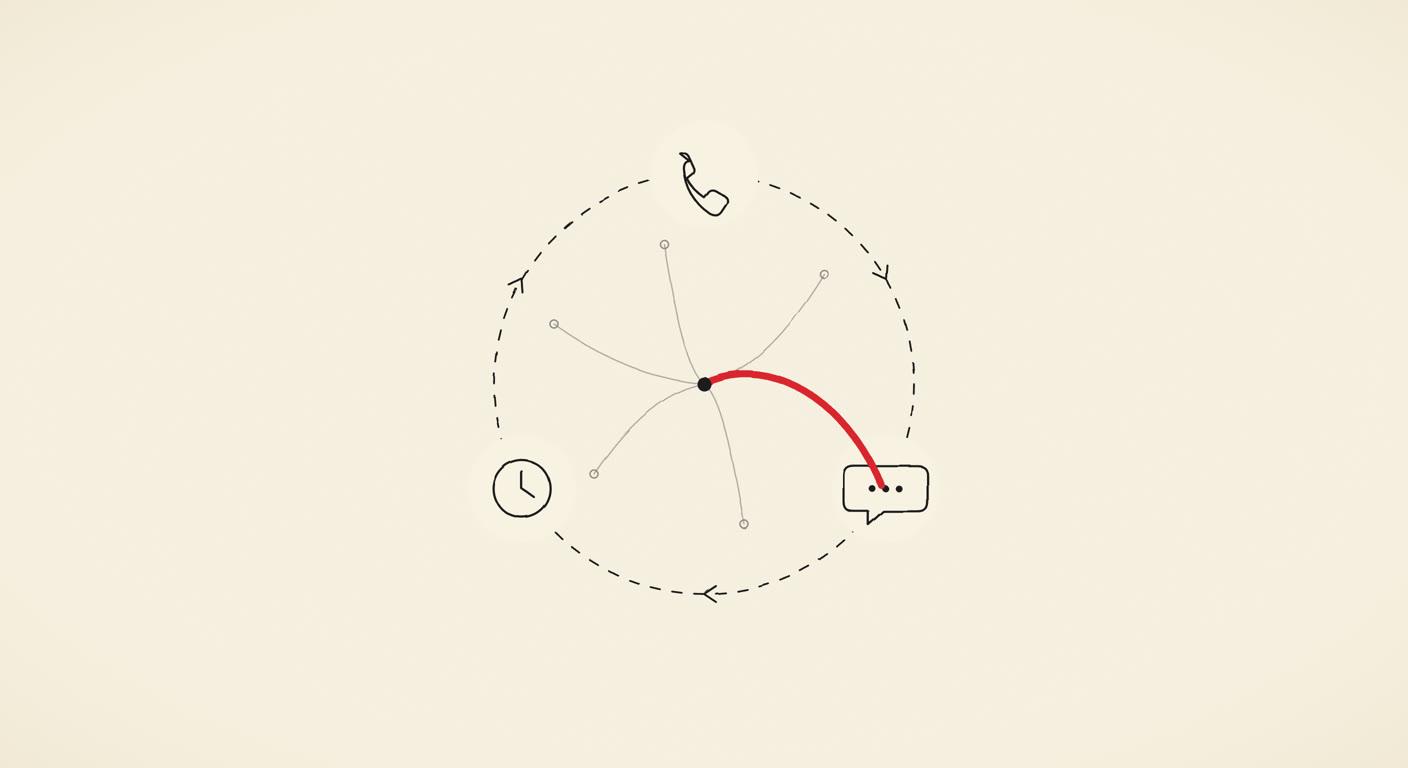
The rules your team writes tell the agent what it is allowed to do: what it may offer, when it may make contact, what it must say. They do not tell it what works. Whether this customer picks up a call at seven in the evening, whether that one only ever answers on WhatsApp, which first line gets a reply and which gets ignored. That has to be learned, and it keeps changing.
This piece explains how SuprAgent learns it. Not the model names or the internals, but the loop, and the checks that stop it from learning the wrong thing.
Three questions, for every customer, every day
Before each step, the agent has to answer three questions for one specific person.
- Can I reach them, and how? Which channel they are likely to see and answer, and at what time. A call at the wrong hour is not just wasted, it costs goodwill.
- What should I lead with? The price, a reminder of what they started, an answer to the question they asked last time, or simply the link.
- What is the right next step? Call, message, send the screen, wait, or hand over to a person. Waiting is often the right answer.
Rules narrow the options. Learning picks among what is left.
Learning from outcomes, not opinions
Every step the agent takes has an outcome. The call was answered or not. The message was delivered, read, replied to, or ignored. The link was opened. The screen was finished, or abandoned at a particular field. The customer said not now, or asked to stop.
Those outcomes are the teaching material. Over time they show patterns that no one would write down as a rule: renewal customers in one city answer more after lunch than before it, people who stalled at document upload respond to a call better than to a reminder, a message that leads with the exact amount gets more replies than one that leads with the brand.
We do not hand tune any of this. The agent's decisions are scored against what actually happened, and the models that make those decisions are updated on a regular schedule as new outcomes come in. Internally we call this continuous MLOps. In practice it means the agent you have in month three makes better choices than the one you started with, for your own customers.
Holdouts keep it honest
A model that learns from its own decisions can fool itself. If it only ever calls people in the evening, it never learns that some of them would have answered in the morning. Two habits guard against that.
The first is the group of customers the agent never contacts at all. It tells you what the agent changed overall, compared with doing nothing new.
The second is a small share of decisions where the agent deliberately tries something other than its current favourite: a different hour, a different opening line, a different channel. Most of the time the favourite is right. When it is not, this is how the agent finds out.
A new model has to earn its place
Customers should never be the test. A new version of a decision model goes through the same steps every time:
| Stage | What happens |
|---|---|
| Check on recent history | It is scored on recent outcomes it has not seen, against the version it would replace |
| Shadow | It makes decisions alongside the live version without acting on them, and we compare |
| A small slice | It acts for a small share of customers, with its results watched closely |
| Everyone | Only then does it replace the old version, which stays ready to come back |
If a new version does worse at any stage, it does not go further. Rolling back is a switch, not a project.
The rules always win
Learning never gets to override what your team wrote down. If the model thinks a third call this week would work, and the rule says two contacts a week across all channels, there is no third call. If the model favours a discount the rules do not allow, the discount is not offered. The learned part chooses within the space the rules leave open, and nothing outside it.
That separation is also what makes the agent explainable. For every step you can see the rule that allowed it and the reason it was chosen over the alternatives.
When the pattern changes
Customer behaviour moves. A festival season, salary week, a price change, a new competitor offer, a change in how a messaging app shows business messages. A model that was right last month can be wrong this month.
So the outcomes are watched, not just collected. When the agent's predictions stop matching what customers actually do, it shows up quickly, and the models are retrained on the new pattern rather than waiting for the next scheduled update.
What it learns from
What the agent may use is agreed with you before it starts: the fields from your systems, the history of past journeys, the consent each customer has given. If a signal is not agreed, it is not used. We would rather the agent be a little less clever than use something your customers would not expect it to know.
Why this matters more than the model
People ask which model we use. It is a fair question, and the honest answer is that it matters less than the loop around it. A very good model with no feedback makes the same mistake a thousand times. A good model that learns from every outcome, tests its changes before customers see them, and stays inside your rules gets better each week.
That loop is what we spend most of our time on. If you want to see what the agent would learn from your own history, book a walkthrough.
Sibi is the founder of SuprAgent, which builds AI agents that follow up with customers on calls, WhatsApp, RCS, SMS, apps and websites for banks, lenders, insurers and retailers. Before SuprAgent he ran the Samsung Care+, AppleCare+ and Vivo V Shield programs at Servify.
Topics
Want to see this on one of your journeys?
Tell us where your customers go quiet and we will walk you through how the agent would handle it. Or try the product yourself.